Why San Francisco Is Heating Up While Other Markets Are Cooling
September 2026 Housing Market Review | San Francisco, San Mateo, Santa Clara & Contra Costa Counties
The Bay Area housing market continues to tell an interesting story as we enter the final quarter of 2026.
Despite elevated mortgage rates and economic uncertainty, buyer demand remains remarkably strong in some communities, while other markets are experiencing more moderate conditions.
September’s sales data highlights a growing divide between the Bay Area’s most affluent housing markets and more affordability-sensitive areas.
For homeowners, buyers, and sellers, understanding these differences is essential when making real estate decisions.
1. September Home Prices: Four Counties, Four Different Trends
Here’s how September 2026 single-family home median sales prices compare with September 2025:
| County | Sept. 2026 Median Price | Year-over-Year Change |
|---|---|---|
| San Francisco | $2,050,000 | +18% |
| San Mateo | $2,170,000 | +9% |
| Santa Clara | $1,870,000 | -4% |
| Contra Costa | $850,000 | Approximately flat |
The biggest takeaway: San Francisco and San Mateo County continue to outperform the other two markets in year-over-year median price growth.
However, median sales prices don’t tell the entire story. They can fluctuate based on the mix of homes sold, including differences in size, location, and price range.
To understand what’s happening, we also need to examine buyer competition, mortgage rates, and economic conditions.
2. San Francisco: The AI Boom Continues to Fuel Demand
San Francisco has experienced a remarkable resurgence in its residential real estate market.
The city’s median single-family home price reached $2.05 million in September, representing an 18% increase from the previous year.
Even more striking is the level of competition.
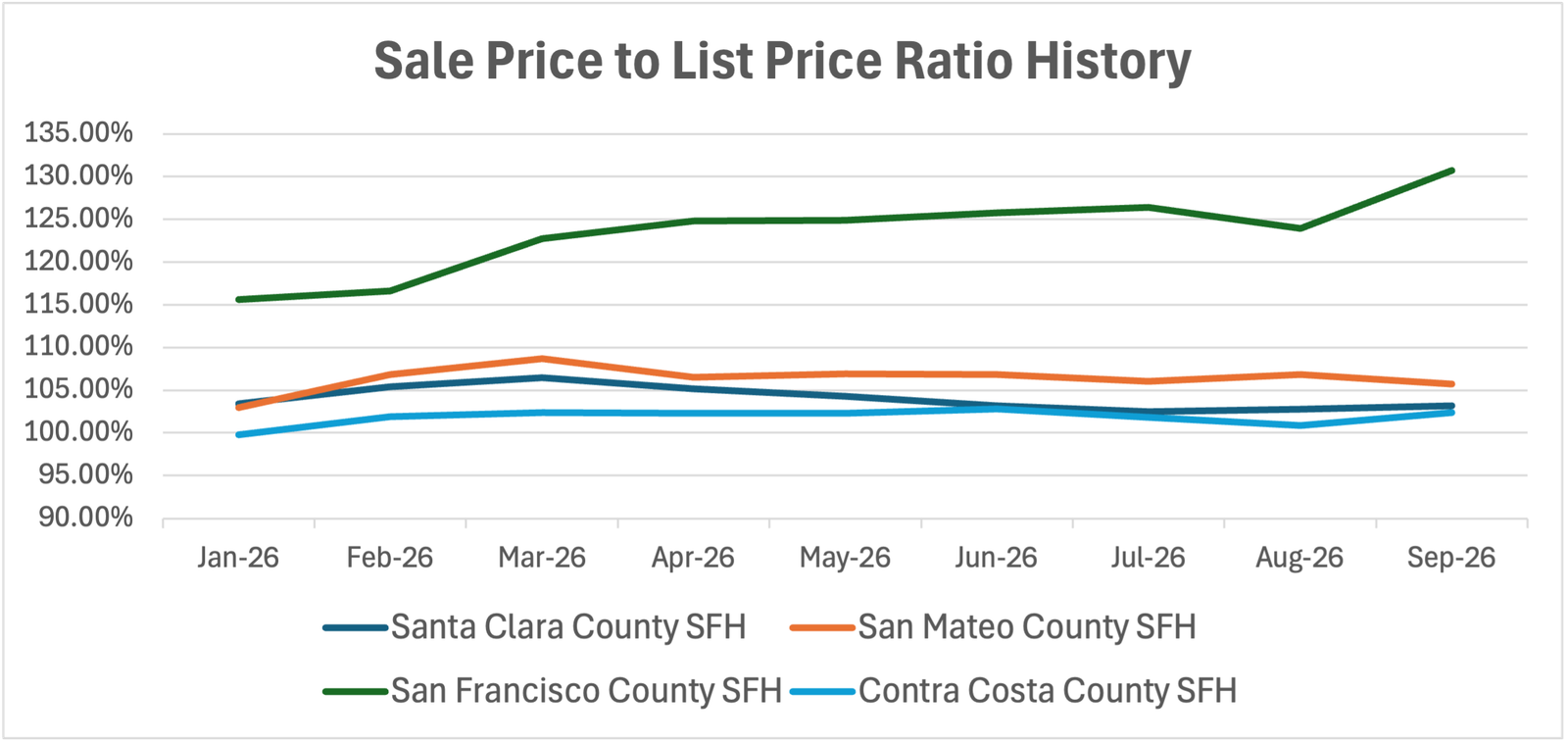
San Francisco’s aggregate sale-to-list price ratio reached 130.7% in September.
That means the total sales price of homes sold was approximately 31% higher than their combined asking prices.
While this statistic doesn’t mean every home sold for 31% over asking, it indicates exceptionally strong buyer competition.
What’s driving this demand?
One important factor is the continued expansion of the artificial intelligence industry.
San Francisco has become a major center for AI startups, attracting entrepreneurs, engineers, investors, and technology professionals.
The resulting wealth creation, particularly through company equity and stock compensation, may be supporting housing demand among affluent buyers.
These buyers can sometimes be less sensitive to mortgage rates because they have substantial assets or the ability to make larger down payments.
For sellers: Strong demand creates opportunities, but pricing and preparation remain critical. A high sale-to-list ratio can also reflect strategic underpricing rather than appreciation alone.
For buyers: Understanding comparable sales and actual market values is essential. The asking price may not reflect what a competitive offer will require.
3. San Mateo County: Strong Demand and Limited Inventory
San Mateo County continues to demonstrate the strength of the Peninsula housing market.
September’s median single-family home price reached $2.17 million, up 9% year over year.
Homes also sold at a median of just 11 days on the market, reflecting continued demand.
Several factors contribute to this resilience.
Location and Employment
San Mateo County benefits from its position between San Francisco and Silicon Valley.
Residents have access to employment opportunities throughout the technology, biotechnology, healthcare, and professional services industries.
Limited Housing Supply
Many Peninsula communities have relatively little room for new single-family home development.
When demand rises faster than inventory, competition can intensify quickly.
Lifestyle and Community Appeal
Desirable schools, established neighborhoods, transportation access, and proximity to major employment centers continue to attract buyers.
For homeowners in Millbrae, Burlingame, San Mateo, Foster City, and surrounding communities, these fundamentals remain important drivers of long-term housing demand.
However, market conditions can vary considerably between neighborhoods and property types.
4. Santa Clara County: A More Balanced Market?
Santa Clara County’s median single-family home price declined approximately 4% year over year to $1.87 million.
This doesn’t necessarily mean the market is weak.
Instead, it may reflect a combination of changing buyer preferences, affordability constraints, and the mix of homes sold.
Although Silicon Valley remains a major center of technology employment and wealth creation, not all technology companies or households are experiencing the same economic conditions.
Some buyers may be taking a more cautious approach because of mortgage costs, employment uncertainty, or stock market volatility.
For buyers, a less aggressive market may create opportunities to negotiate on properties that have been listed longer.
For sellers, competitive pricing and thoughtful preparation become particularly important when buyers have more choices.
5. Contra Costa County: Affordability Plays a Bigger Role
Contra Costa County provides an interesting comparison with the Peninsula.
With a median single-family home price around $850,000 in September, it remains considerably more affordable than San Francisco, San Mateo, and Santa Clara counties.
However, buyers in more affordable markets may be more sensitive to changes in mortgage rates.
For example, a one-percentage-point increase in mortgage rates can substantially affect a household’s monthly payment and purchasing power.
This may cause some buyers to postpone their plans, reduce their target price, or explore different neighborhoods.
The relatively flat year-over-year median price suggests a different market dynamic from the stronger appreciation seen in San Francisco and San Mateo County.
For buyers seeking more space at a lower price point, Contra Costa County may offer opportunities worth exploring, depending on commuting needs and lifestyle priorities.
6. Mortgage Rates: Why Small Changes Matter
Mortgage rates remain one of the most important variables influencing housing affordability.
After periods of significant volatility, buyers are closely watching economic reports, inflation data, and Federal Reserve policy for clues about where rates may go next.
One important distinction is that the Federal Reserve doesn’t directly set mortgage rates.
Mortgage rates are influenced by bond yields, inflation expectations, economic growth, and financial market conditions.
Even relatively small changes can have meaningful consequences for buyers.
An Example: How Mortgage Rates Affect Purchasing Power
Consider a buyer purchasing a $1 million home with a 20% down payment.
The mortgage amount would be $800,000.
| 30-Year Fixed Rate | Monthly Principal & Interest |
|---|---|
| 6.0% | $4,796 |
| 6.5% | $5,057 |
| 7.0% | $5,322 |
| 7.5% | $5,594 |
Illustrative calculations; excludes property taxes, insurance, HOA fees, and other expenses.
The difference between a 6% and 7.5% mortgage is approximately $798 per month.
That’s nearly $9,600 annually.
For buyers, this underscores the importance of reviewing financing options and obtaining updated preapprovals before making offers.
For sellers, it helps explain why some buyers are more price-sensitive than others.
7. Is Fall a Good Time to Buy or Sell?
Historically, the Bay Area housing market experiences seasonal changes in activity.
Spring typically brings the strongest buyer demand and the greatest number of transactions.
As fall progresses toward the holiday season, fewer homes are generally listed, and some buyers temporarily step away from their searches.
However, this seasonal slowdown can create opportunities.
Opportunities for Buyers
Buyers who remain active during the fall may benefit from:
- Less competition on some properties.
- More negotiating opportunities on homes with extended days on market.
- Sellers who are motivated to complete transactions before year-end.
That said, desirable homes can still attract multiple offers, particularly in competitive Peninsula neighborhoods.
Opportunities for Sellers
Fall can also be a productive time to sell.
Although fewer buyers may be actively searching, those who remain in the market are often serious about purchasing.
With fewer competing listings, a well-prepared and strategically priced home may stand out.
The key is understanding the specific conditions in your neighborhood rather than relying solely on seasonal averages.
8. What Should Homeowners Watch Going Into 2027?
As we approach the end of 2026, several factors could influence the housing market.
Mortgage rates: Any sustained decline could improve affordability and encourage more buyers to enter the market.
Technology-sector wealth: Continued growth in AI and related industries could support demand in San Francisco and Silicon Valley.
Housing inventory: The number of homes available for sale will remain a critical factor in determining buyer competition.
Employment and consumer confidence: Economic uncertainty could influence buyers’ willingness to make major financial commitments.
Local market differences: Price trends will continue to vary by county, city, neighborhood, and property type.
For homeowners, these differences make a personalized market analysis more valuable than broad regional statistics.
The Bottom Line: Real Estate Is More Local Than Ever
September’s housing data reinforces an important lesson.
There isn’t one Bay Area housing market. There are many different markets operating within the same region.
San Francisco’s AI-driven demand is creating intense competition, while San Mateo County continues to benefit from limited inventory and desirable communities.
Santa Clara County is experiencing more moderate median price trends, while Contra Costa County provides a more affordability-focused alternative.
Whether you’re buying, selling, downsizing, or considering an investment property, the best decisions begin with understanding the market relevant to your goals.
Let’s Discuss Your Real Estate Goals
Are you wondering how these trends affect your home’s value or whether now is the right time to make a move?
As a local Realtor serving San Mateo County and the surrounding Bay Area, I help families understand market conditions and develop real estate strategies aligned with their financial and lifestyle goals.
Whether you’re planning to sell, purchase your next home, downsize, or help a family member with a housing decision, I’d welcome the opportunity to help.
Schedule a complimentary real estate consultation to discuss your goals and explore your options.
Or, if you’re simply curious about your home’s current value, request for a personalized home value analysis based on recent sales and current market conditions in your neighborhood.